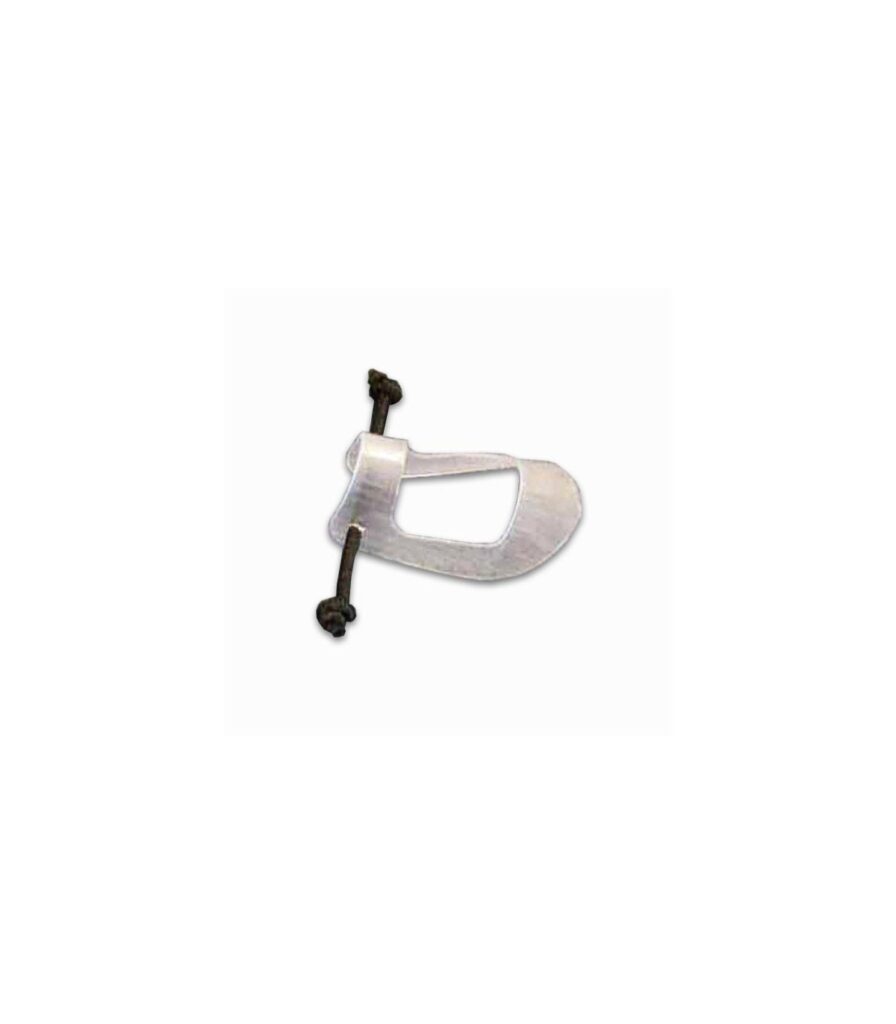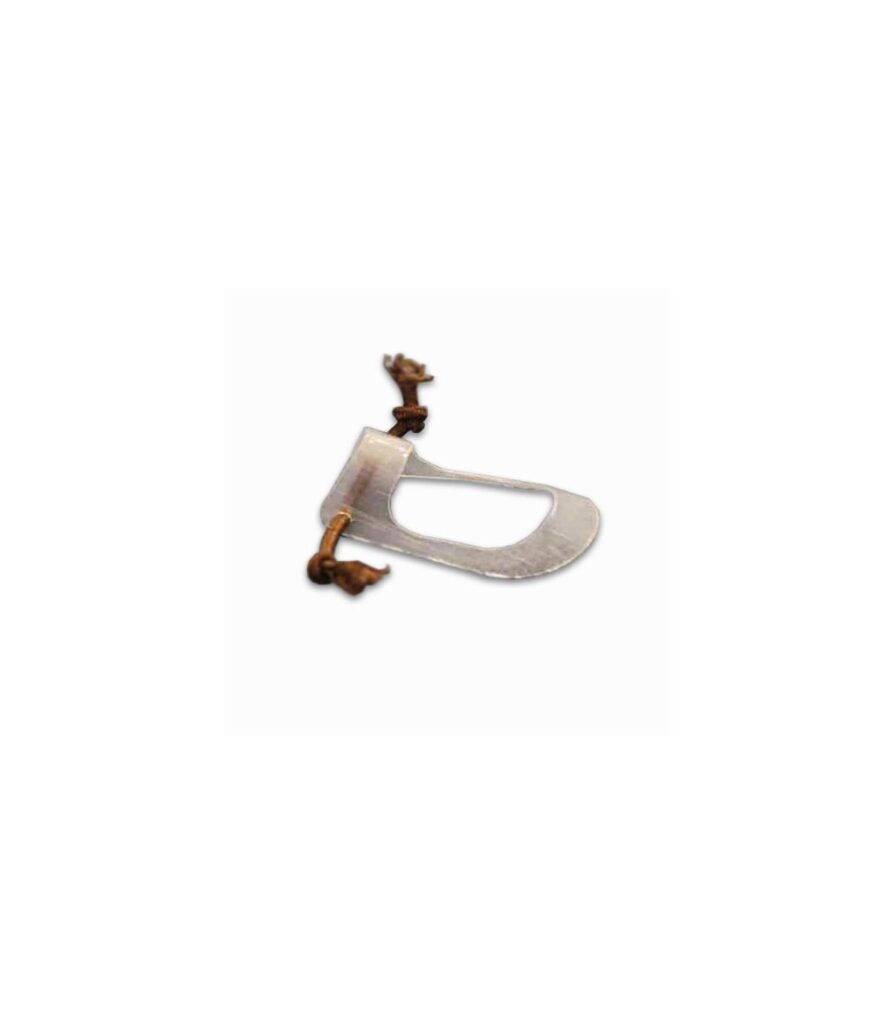
Making your own fingerpicks for Portuguese guitar is a bit like a rite of passage: you go from a simple accessory to a tool that is perfectly suited to your hand and your sound. However, making them is easier than it looks.
1. Draw the fingerpick
First, draw two nail shapes, one for the index finger and one for the thumb. For the index finger, draw a rectangle 2.5 cm wide and 3 cm long. For the thumb, draw a square with sides measuring 3 cm. The dimensions will also depend on the size of your hand, but feel free to try out a few different sizes. Then trace the inside, leaving a margin of about 0.5 cm to allow the nail to pass through.
If you prefer to shape the nails once they are on the plastic, you can cut them directly as they are. If you want to save time at the risk of having to redo them, round the corners of the thumbnail very slightly. For the index finger, we have two options:
Coimbra – For this style, you can draw two well-rounded lines starting from the middle of the length and joining them in the middle of the width of one of the sides. This gives us a nail shape typical of Coimbra guitarists, who usually played with their natural nails.
Lisbon – These nails require less preparation as they are usually more square. However, the left side of the nail should be slightly shorter than the right side. You should therefore draw a diagonal line starting about 0.5 cm below the length of the nail.
If you have a guitar pick that is large enough, you can use it to draw the shape of the index finger. However, you will need to make sure that it is sufficiently rounded toward the tip.

2. Choosing a good plastic material
Once you have drawn your template, choose a plastic sheet that is rigid enough to support the metal strings of the Portuguese guitar: rigid vinyl, acrylic, polycarbonate, or polypropylene work well. A thickness of approximately 0.5 mm to 1 mm generally provides a good balance between rigidity and comfort, similar to the feel of a thick pick.
3. Cutting the template out of the plastic
Use your template (the one made from the pick) and place it on the plastic sheet. Then carefully cut out the shape with a pair of sturdy scissors or a craft knife, staying slightly outside the outline to leave room for sanding.
4. Make a hole for the natural nail
On the side that will be closest to the cuticle, create an opening so that your natural nail can fit into the false nail and be secured in place. You can make:
- An oval hole or a small elongated window,
- Placed far enough from the edge so that the plastic remains strong.
Test regularly on your finger to check that the nail fits well, without pinching or gaping too much.
5. Finishing the playing edge and fastening
The sound is determined by millimeters, so the finish is crucial.
- Use sandpaper to roughen the edge, then smooth it down.
- Slightly round the tip as you would with a pick, testing it often on the guitar to feel the attack.
- If the sound is too aggressive, round it off more and polish it further; if it’s too soft, keep the edge a little sharper.
For attachment, many players use:
- Surgical tape wrapped around the finger and nail, or an elastic band placed across the base of the nail.
- A thin strip is enough to keep the nail in place, while allowing it to be easily removed after the session.
The most important thing is to test, adjust, play again… and keep your first model as a basis for making the next ones.